
Engineering Design Team Places Second in Raytheon Drone Competition
An interdisciplinary team of nine Ole Miss engineering students competed in the annual Raytheon drone competition and came away with invaluable professional experience and a runner-up finish.
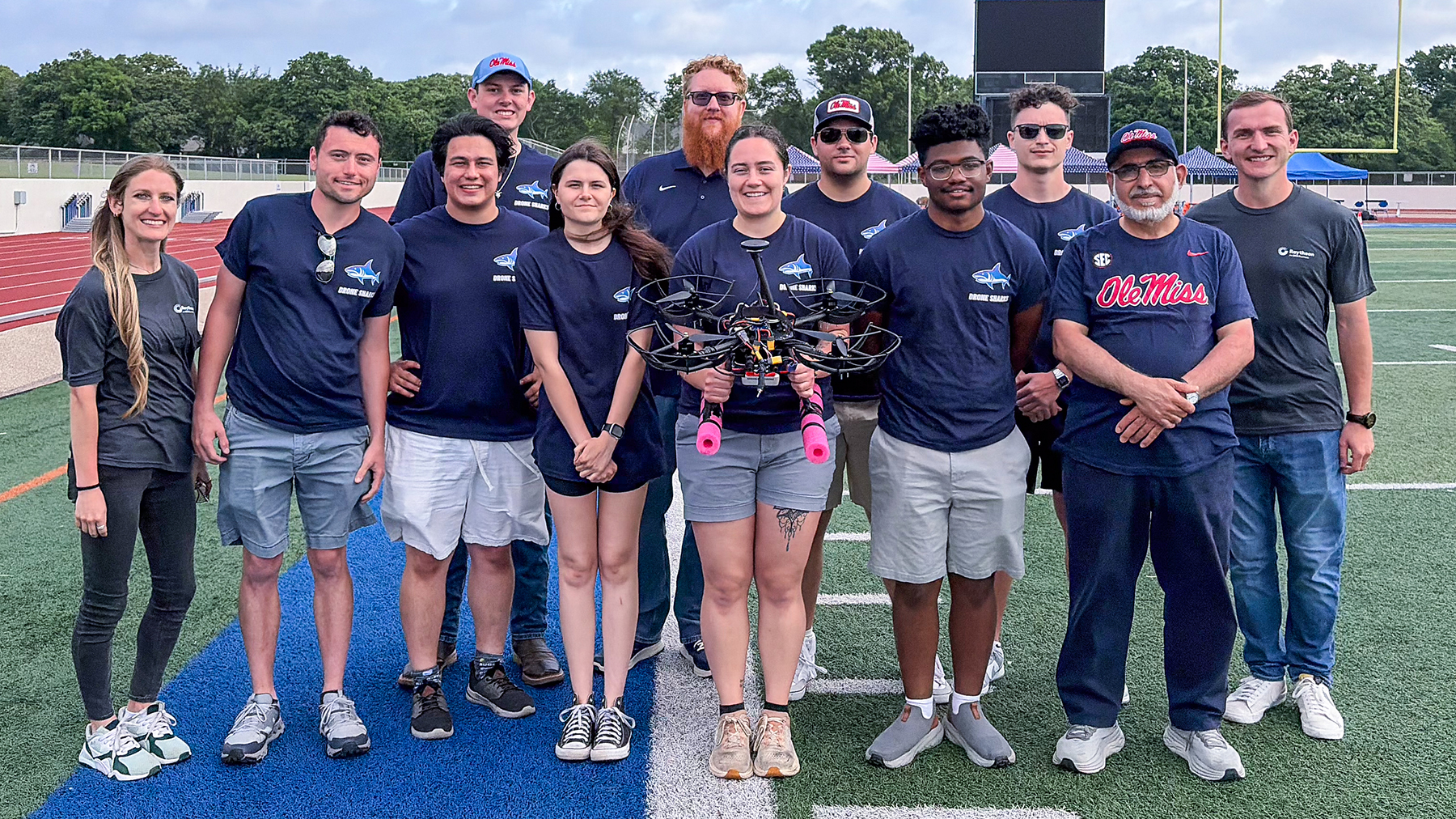
ARLINGTON, Texas – A group of nine Ole Miss students across four engineering disciplines teamed up to meet a unique set of challenges at the 2026 Raytheon Autonomous Vehicle Competition (AVC), and they came away with an invaluable professional experience, as well as a second-place finish in a tough field.
The AVC is a student engineering challenge focused on solving real-world problems through the design of fully autonomous systems. This year, teams were charged to develop and test both an unmanned aerial vehicle (UAV) and an unmanned ground vehicle (UGV) that work together without human control.
Led by Emma Freeman, a senior electrical engineering major and Taylor Medalist, the team began in September with six initial drone designs, researching the latest drone technologies before deciding on their final design and ordering all the components. Piece by piece, their drone arrived over Christmas break.
“We bought a frame, we bought like a bunch of sensors, batteries, motors, propellers, flight controller,” Freeman said. “Then when we came back this semester, we did the same thing with the ground vehicle and started actually building it and putting it together. And it's all custom-built.”
Then, the group went to work, taking on the name, “Drone Sharks.” Along with Freeman, the team included seniors Aiden Abas (Computer Engineering), Joshua Downs (Electrical Engineering), Trace Fulford (Electrical Engineering), Earnest James (Computer Science), Nathan Prestage (Mechanical Engineering), Ember Reysen (Computer Science), Bryson Schnitta (Electrical Engineering) and Jacob Valentine (Mechanical Engineering).
They were guided by faculty advisors Dr. Mustafa M. Matalgah, professor of electrical and computer engineering; Dr. Tejas Pandya, instructional professor of mechanical engineering; and Dr. Charles Walter, assistant professor of computer and information science; along with Raytheon advisors and Ole Miss alumni Aly Parsons Bybee and Caleb Keathley.
But just when the Drone Sharks really dove into their project, it came to a halt when Winter Storm Fern hit Oxford and shut down the town for two weeks. When the university reopened, the team had just two months to build, program and test their vehicles—minus another week for spring break—leading to the first real-life engineering challenge of the event: making it all come together and work on a short deadline.
“It’s a big shift in academic setup from theory to practice. They learn all engineering, like mechanical, electrical, computer software, computer vision. They integrate the complete system from scratch,” Matalgah said. “And the challenge is the integration part of it. How those different pieces interface with each other. From different vendors, different companies. Make sure they work together, they communicate together. Sometimes it doesn't work, we have to return it and check again.”
The electrical and mechanical engineers had constructed their UAV and UGV by spring break, while the computer scientists trained modules to classify images and keywords for automation and integrated the hardware and software. Then the testing process was compressed into a hectic final month after spring break, leading up to the competition on April 16-17. James, Reysen and Downs—the three on the team with pilots’ licenses—were out in the field testing their systems and solving problems day and night.
It was a month of trial and error—and then more trial and error. The group found itself facing real-world engineering problems one after another, but Downs made sure the team didn’t lose hope.
“One day, we were having issues with the GPS. Then we found out there was like a slight issue with the cable that connected to the flight controller. So, we solve that. The next day we come in and we're getting a different error. So, we solve that,” Downs said. “Every day we were inching closer and closer, but it was like every time we inched closer, we kind of unlocked three new problems that needed to solve.”
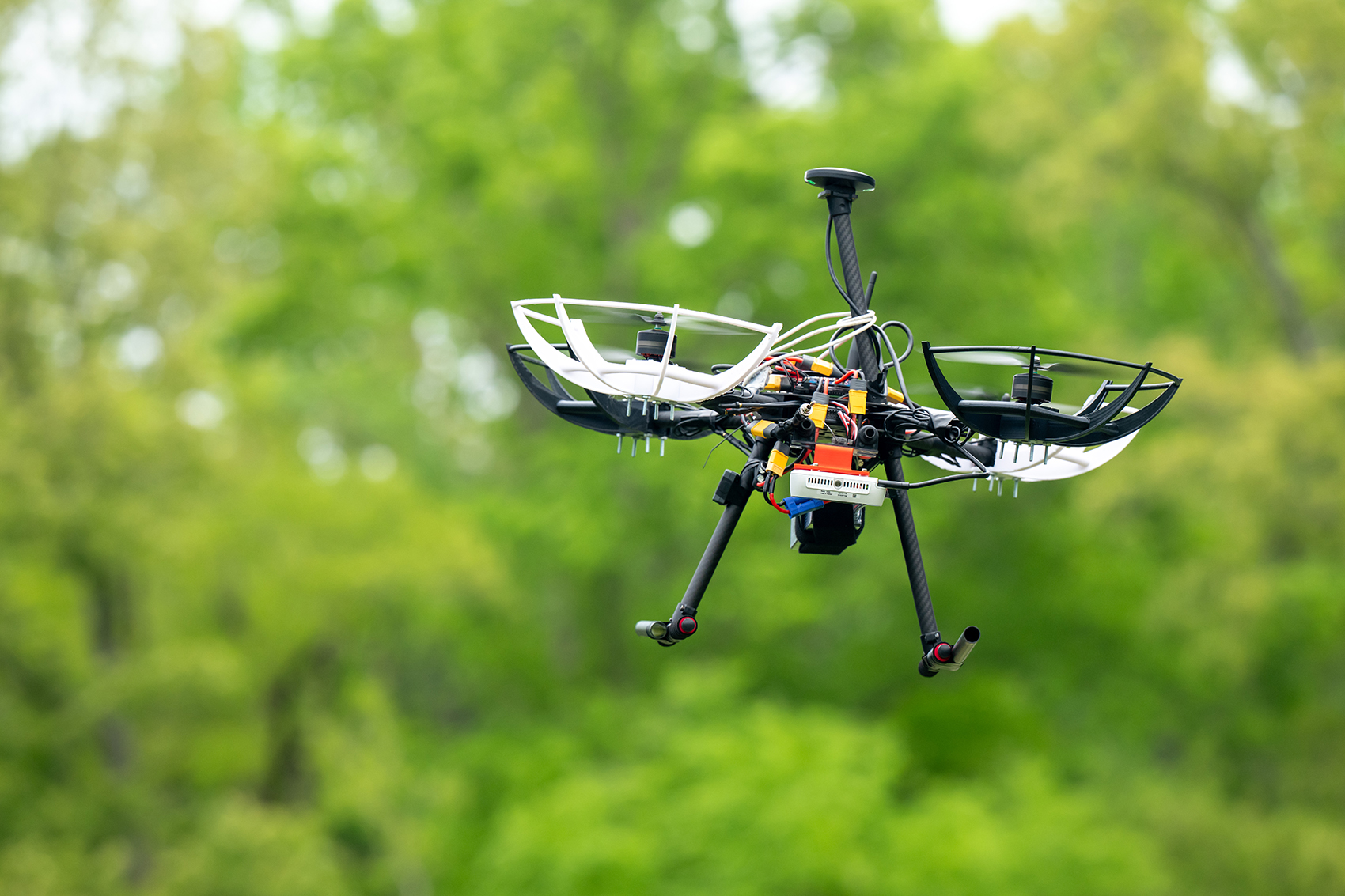
When the competition came, the problem-solving only continued. Competing at the University of Texas at Arlington, along with 10 other schools, they spent their first two days testing their vehicles, and the third was the competition itself. The challenge was entirely automated: From the UGV, the UAV flies up, identifies a target and communicates to the UGV to go to that target. Once the UGV is on its way, the UAV lands back on the ground vehicle.
The team had just 30 minutes to attempt, troubleshoot and complete each task. Ultimately, the Drone Sharks were able to display each individual component of the challenge. They earned the second-most points, finishing behind only UT-Austin and ahead of host UT-Arlington, as well as Texas A&M and others. As a bonus, the Raytheon employees said they showed the most grit.
“Definitely hectic, definitely stressful. But I think that's part of why they said we had the most perseverance,” Freeman said. “Because we were showing active engineering problem-solving under pressure. Everyone, Raytheon employees watching us, grading us as we're trying to fix things on the field in real time.”
That experience was the biggest takeaway for the Drone Sharks. They took lessons from the classroom, then put them into practice. They put in extraordinary work on the front end, then learned that the engineering has only just begun once everything looks good on paper. They tested repeatedly, then learned to solve problems when the stakes were highest. In short, they became engineers.
“It feels like they went from being students to engineers over the course of this project,” Walter said. “Because it was a real-world project, it's a real, incredibly difficult project. That's incredibly exciting to watch.”
Support the School of Engineering
You can help lay the foundation for the next generation of Ole Miss engineers. Click here to donate to the School of Engineering to support our students and faculty today.
Follow the School of Engineering
Stay up to date with the latest news and events for the School of Engineering. Follow @olemissengineer on X, @olemissengineering on Instagram, Ole Miss Engineering on Facebook and our new LinkedIn page, The University of Mississippi School of Engineering.
By
Alex Sims
Campus
Office, Department or Center
Published
May 19, 2026